
Sacred Tobacco: A Shamanic Tool for Protection and Prayer
If you have attended an ayahuasca ceremony — or spent time researching what one looks like — you will likely have encountered the thick, pungent smoke of mapacho. Rolled into large rustic cigars, cigarettes or smoked through a pipe, its presence in ceremony is unmistakable. If you are newer to what a ceremony looks like in practice, our Ayahuasca Ceremony page gives a detailed overview of what to expect.
To the uninitiated, it might look like an unusual cultural habit. To anyone who understands its role in Amazonian shamanism, it is something else entirely: one of the most powerful and versatile healing plants in the traditional pharmacopoeia of the Shipibo and other indigenous Amazonian traditions.
Mapacho — the name commonly used for sacred tobacco in the Amazon — is not recreational tobacco. It carries no resemblance, spiritually or practically, to the commercialised product most people in the West associate with the word tobacco. It is a master plant: a protector, a prayer vehicle, a diagnostic tool, and an energetic cleanser that has been central to indigenous healing traditions across the Amazon for thousands of years. This is its story.
What Is Mapacho?
Mapacho is the common name for Nicotiana rustica — a species of tobacco native to the Americas that is considerably stronger than the commercial variety used in cigarettes. It contains significantly higher concentrations of alkaloids, which in the shamanic context are understood not as a health risk but as the source of the plant’s spiritual potency.
In the traditional Amazonian worldview, every plant carries a spirit — an intelligence that can be worked with, communicated with, and called upon for specific purposes. The spirit of tobacco is understood as a powerful protector, a clearer of negative energies, and a bridge between the ordinary world and the spirit world. Mapacho is smoked, applied as smoke, drunk in decoction, and used as an energetic tool in ways that have no equivalent in Western herbalism.
Among the Shipibo of the Peruvian Amazon, mapacho is inseparable from ceremonial practice. It is present at every ceremony at Nimea Kaya — not as a background feature but as an active, functional element of the healing work. To understand the broader healing context it operates within, visit our Ayahuasca Healing page.
Mapacho Is Not Inhaled — Understanding How It Is Used
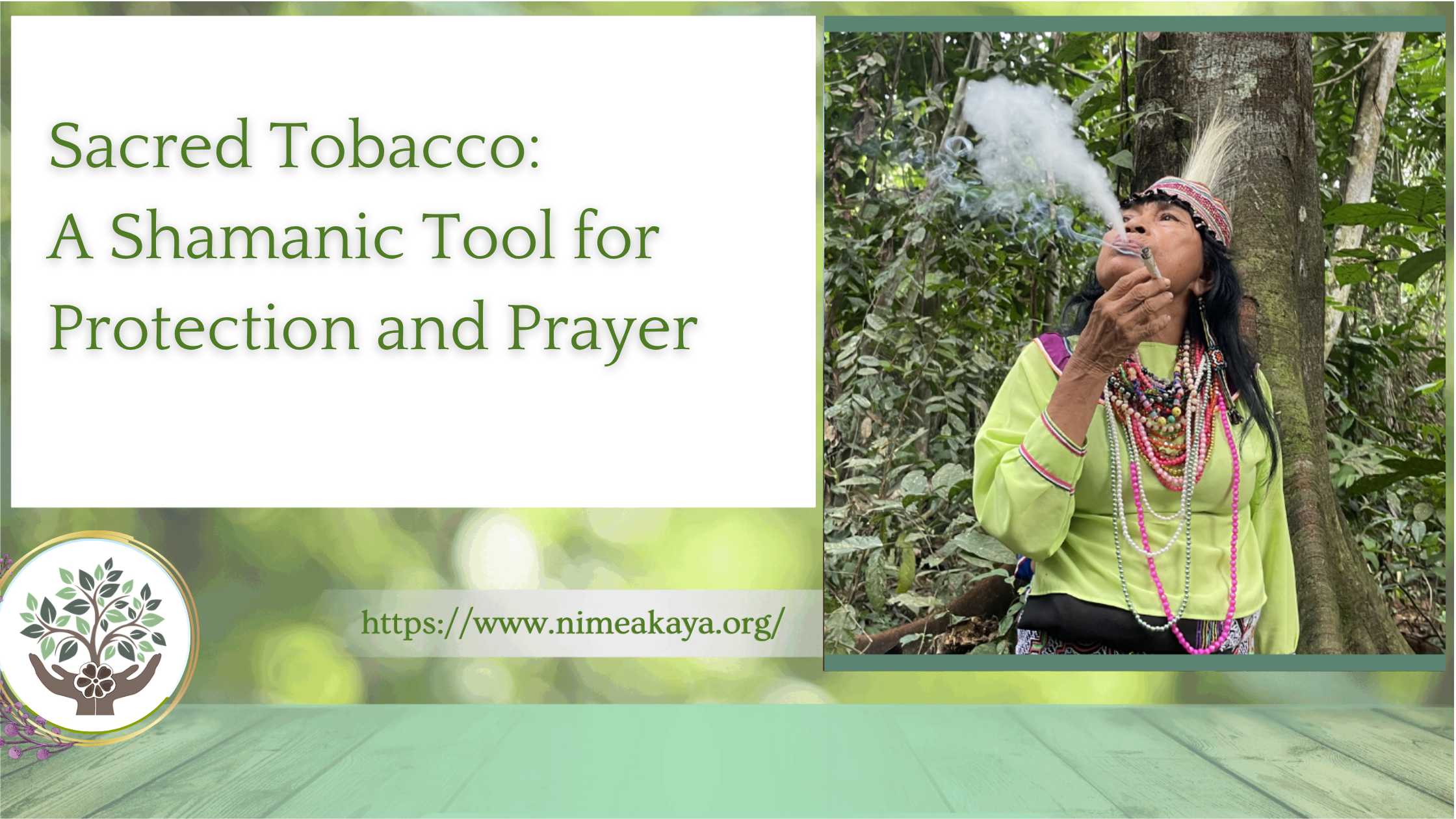
This is one of the most important distinctions for Western participants to understand: traditional mapacho is not inhaled into the lungs. It is puffed — drawn into the mouth and held briefly, like one would smoke a cigar. The smoke is used externally, directed through the breath and through intentional technique. The plant is being worked with as an energetic tool, not consumed as a stimulant.
When a Shipibo maestro works with mapacho in ceremony, every gesture is intentional. The smoke is the carrier — the vehicle through which protective and cleansing energy is directed. The maestro is not simply smoking. They are working.
The Core Uses of Mapacho in Shipibo Ceremony
Protection
One of the primary functions of mapacho in ceremony is protection — specifically, the creation and maintenance of an energetic boundary around the ceremonial space and around the participants within it.
Shamans work in the spirit world alongside the ordinary world. In this terrain, the ability to establish and maintain clear boundaries between energies is essential. Mapacho smoke, directed with intention and accompanied by prayer, creates what practitioners describe as a protective field — an energetic seal that keeps unwanted energies out of the ceremonial space and keeps the participants within it safe during their journey.
This protection is considered active, not passive. The maestro works with the spirit of the tobacco consciously, calling on its protective intelligence throughout the ceremony as needed. Learn more about the incredible Shipibo healers who carry this knowledge on our Our Team page.
Clearing and Cleansing — The Limpieza
Mapacho smoke is a primary tool for energetic cleansing — of spaces, of objects, and of people. In this respect it functions similarly to sage in the North American indigenous tradition, though within its own distinct framework.
Before a ceremony begins at Nimea Kaya, the maestros perform a limpieza — a thorough energetic cleansing of the maloca ceremonial space. Mapacho smoke is blown throughout the space, into each corner, across the floor and ceiling and walls, with the specific intention of clearing any accumulated negative or stagnant energies and preparing the space to serve as a sacred container for the work ahead.
The maloca is not merely cleaned physically for ceremony. It is prepared energetically. This preparation is considered as important as any other aspect of setting up the ceremonial space.
Prayer
In the Shipibo tradition, mapacho smoke is a vehicle for prayer — a way of sending intention, gratitude, and petition into the spirit world. When a maestro blows smoke upward, or in the four directions, or toward the earth, they are communicating. The smoke carries the prayer outward in a form that the spirit world can receive.
This use of tobacco as a prayer medium is not unique to the Amazon. Across many indigenous traditions worldwide, smoke — whether from tobacco, sage, copal, or other sacred plants — has served as the connection between the human and the divine.
The Soplado: A Seal of Protection for Participants
One of the most distinctive uses of mapacho in Shipibo ceremony is the soplado — a technique in which the maestro blows mapacho smoke directly onto a participant as a protective seal following the singing of an icaro to them.
The process involves the maestro approaching a participant, singing their individual healing song, and then blowing mapacho smoke onto specific points of the body: the crown of the head, into the open hands held upward, and over other parts of the body as indicated by the healing that is taking place.
The soplado serves multiple purposes simultaneously: it seals and protects the energetic work that the icaro just performed, it clears any negative energies around that person, and it provides a kind of energetic armour for the participant as they continue their journey through the ceremony.
Guests at Nimea Kaya who receive a soplado during ceremony frequently describe a palpable shift — a sense of grounding, clarity, or protection that arrives with the smoke. Whatever one makes of its mechanism, its effects are consistently noticed.
At Nimea Kaya, traditional Shipibo healing tools — including mapacho, icaros, medicinal plant baths and more — are woven into every ceremony. Explore our 7 & 9-day retreat programs to see the full itinerary, or view upcoming dates and prices here.
Dieting with Tobacco: How Shamans Deepen Their Relationship with the Plant
In the Shipibo tradition, working deeply with any master plant — including mapacho — involves a process called a dieta. A dieta is an extended period of isolation, dietary restriction, and sustained, focused engagement with a specific plant spirit. It is how curanderos develop their healing knowledge and deepen their relationship with the plants they work with.
A tobacco dieta is considered one of the more demanding plant dietas because of the sheer potency of the plant. During a tobacco dieta, the maestro will make a concentrated decoction from the tobacco plant — a strong preparation that is drunk at intervals throughout the dieta period. This is an entirely different experience from smoking mapacho; it works from the inside, in sustained, deep engagement with the spirit of the plant.
Through this process, the curandero receives teachings directly from the plant — songs, knowledge, techniques, and a deepened capacity to work with the tobacco’s protective and cleansing intelligence in ceremony. The knowledge they carry was earned in relationship with the plant itself.
This is why the lineage and training of the healers at any retreat centre matters so deeply. The Shipibo maestros at Nimea Kaya carry decades of this earned knowledge. You can read more about their backgrounds on our About Our Healers page.
Mapacho Outside of Ceremony
Mapacho’s uses are not limited to the ceremonial context. Shipibo practitioners work with it in daily life as a tool for maintaining energetic hygiene and protection.
Smudging with mapacho smoke — moving the smoke through a living space or around a person — is used to clear accumulated negative energies in the same way that other traditions use sage or palo santo. Curanderos may also use mapacho as a diagnostic tool — observing the quality and behaviour of the smoke as they work with a patient to gain information about the energetic condition of what they are treating.
For guests at Nimea Kaya who wish to understand more about the plants and practices used in ceremony, our Ayahuasca Resources page is a useful starting point, and conversations with our maestros offer an extraordinary window into a body of knowledge that has no equivalent in Western medicine.
Why This Matters for Retreat Participants
For many guests arriving at Nimea Kaya for the first time, the presence of mapacho in ceremony is unexpected. Some are surprised by the smoke. Some are uncertain about its role.
Understanding what mapacho is and what it is doing in ceremony can significantly change a participant’s relationship to it. Rather than an unfamiliar distraction, it becomes legible — an active, intentional element of the healing container that the maestros are maintaining throughout the night.
When a maestro approaches you with mapacho, when the soplado is given, when smoke is used to cleanse the space before ceremony begins — these are not formalities. They are working practices, carried forward from a lineage of healing knowledge that has been refined and deepened over many generations. Receiving them with openness and respect is itself a form of participation in the ceremony.
If you are preparing for your first retreat and want to arrive with a thorough understanding of what to expect, our Ayahuasca Retreat Preparation page — and our
Ayahuasca Diet guide — cover everything you need to know before you arrive.
Mapacho is one of the great master plants of the Amazonian tradition — misunderstood in the West, essential in the maloca. It is a protector, a prayer, a clearer of paths and spaces, and a medicine in its own right.
The Shipibo maestros at Nimea Kaya have worked with this plant for their entire lives. The relationship they carry with its spirit is part of what makes the ceremonies they lead so safe, so deep, and so effective.
Every element of a properly held ceremony — the icaros, the mapacho, the medicinal plant baths, the dieta, the structure of the retreat itself — exists for a reason. Trusting that reason, and meeting the ceremony with the openness it deserves, is the beginning of real healing.
Ready to Begin Your Journey?
Experience the full depth of traditional Shipibo healing at Nimea Kaya — including the sacred tools and practices that have guided this work for generations. Apply for a retreat here or explore our retreat programme and itinerary.
About the Author – Jill LEvers
Jill Levers has been passionately writing about Ayahuasca for nearly 20 years, sharing her insights and experiences to inspire and educate others about its profound healing potential. Ayahuasca has played a transformative and central role in her life and work. Her first encounter with sacred medicine in Peru in 2007 marked a profound turning point in her spiritual journey. During her second ceremony, Jill felt a deep calling from Ayahuasca to dedicate her life to helping others heal and transform.
This experience inspired her to co-found the Tierra Vida Healing Center in 2008, which later evolved into the Nimea Kaya Healing Center in 2013. For over 17 years, Jill has served as a bridge between the Western world and the traditional Shipibo.
